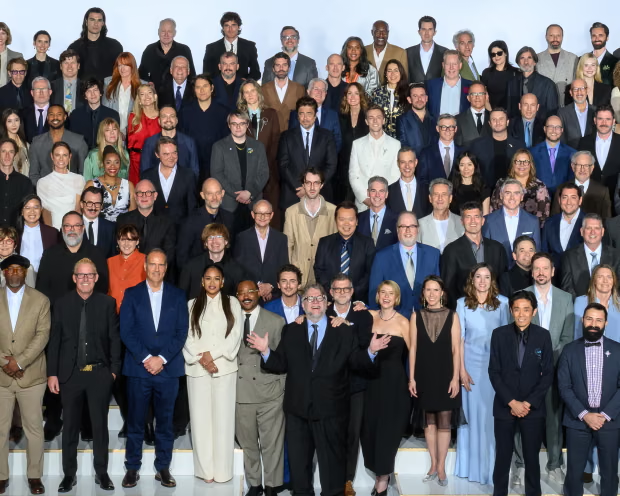
The picture, taken with Paul Thomas Anderson at this year’s Oscar nominee lunch, recalls the eerie image that closes Kubrick’s 1980 horror classic
Frankenstein director Guillermo del Toro’s “jazz hands” pose in the Oscar nominee luncheon photo was part of his and fellow director Paul Thomas Anderson’s attempt to recreate the celebrated group shot, featuring Jack Nicholson, that appears at the ending of The Shining.
Del Toro responded to a post – in which he and Anderson had been inserted into the image from the 1980 horror film directed by Stanley Kubrick – by saying: “[Y]ou got it! PTA and I said: Let’s do the Shining pose and we tried.”
The original picture forms the mysterious final shot of The Shining, and shows Nicholson among a group of partygoers in a photo captioned: “Overlook Hotel – July 4th Ball – 1921”. In the photo, Nicholson has raised his right arm, on which a mustachioed fellow partygoer behind him has placed his hand.
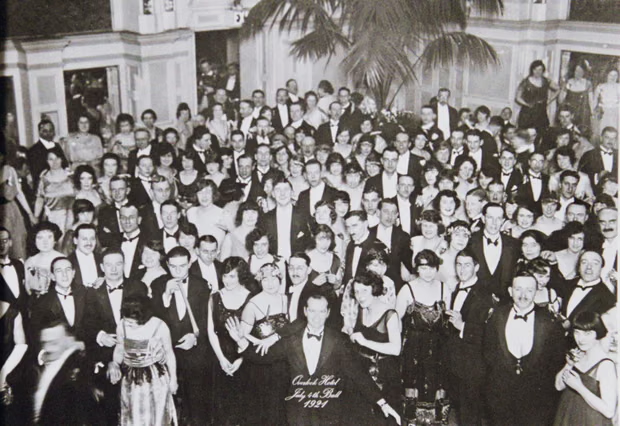
In 2025, New York Times reporter Aric Toler said that he and British academic Alasdair Spark had tracked down the source of the Nicholson picture, which is an edit of a much older photograph. Kubrick had obtained the photo, which was of a Valentine’s Day dance at the Royal Palace hotel in London in 1921, from the Hulton picture archive (now owned by Getty Images) – with Nicholson’s head replacing that of well-known dance instructor Santos Casani.
An incredible self-own
In 1936, John Scott, son of the late Guardian owner and legendary editor CP Scott, did something unheard of for a media heir: he gave up his stake for the greater good.
After inheriting the newspaper, Scott renounced all financial benefit – bar his salary – in the Guardian (worth £1m at the time and around £62m today) and passed ownership over to the newly formed Scott Trust. The Trust would evolve to have one key mission: to secure the financial and editorial independence of the Guardian in perpetuity.
That means the Guardian can’t be bought. Not by private equity, not by a conglomerate, and definitely not by a billionaire looking for a political mouthpiece.
Our independence means we can say what we want, report on who we want, challenge who we want, and stand up at a time when others are sitting down.
But this unique model also means we depend on readers like you from Pakistan to help fund our work. If you would rather the news you read was the result of decisions made by journalists and editors, not shareholders or ultra-wealthy tech bros, then, well, you know what to do: